what happened to pontius pilate when he died
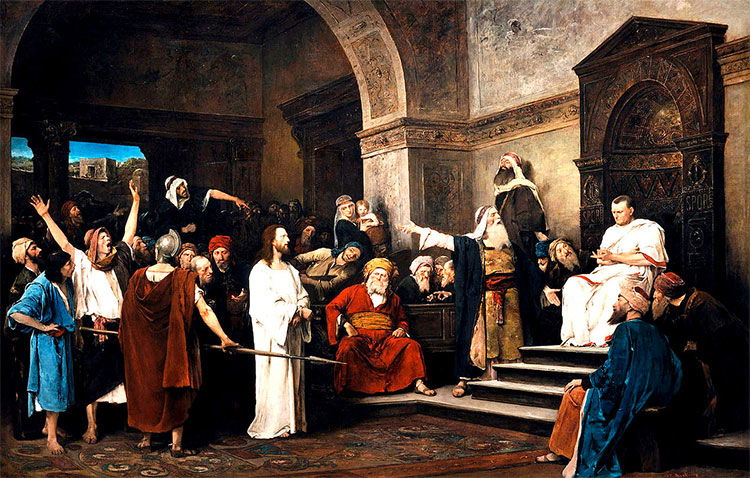
Towards the end of the 2nd century AD the pagan intellectual Celsus wrote an anti-Christian treatise mocking belief in Jesus Christ. If Jesus really had been the Son of God, he asked, why hadn't God punished Pontius Pilate, the human being responsible for crucifying him? Why had Pilate not been driven insane or torn apart, like the characters in Greek myths? Why had no calamity befallen him?
While at that place are plenty of subsequently Christian traditions about the punishment of Pontius Pilate, all of these seem to belong to a period long after Celsus was writing. Celsus' challenge, and the response of early Christians to it, suggests that there was more a kernel of truth in the merits that the Prefect of Judaea had evaded misfortune. This is implicit from the efforts early Christians made to absolve him of responsibility for the Crucifixion.
The simply reliable statement we have about Pilate'south life after his time in Judaea comes from the pen of the Jewish writer Josephus. In his Antiquities of the Jews, written about lx years after the events, Josephus states that Pilate was recalled to Rome after his mishandling of a riot involving the Samaritans in AD 36. For this he would take expected to face up a hearing before the Emperor Tiberius, the aged but uncompromising ruler who had appointed him ten years earlier. Pilate hurried back, merely past the time he arrived, in March Advertizing 37, the ailing Tiberius had died. A new emperor, Caligula, had taken up the reins of power.
What happened next is guesswork. Josephus says nothing more most him, implying that there was no hearing. Mayhap, in the general euphoria surrounding Caligula's accretion, his case was put on hold, or simply forgotten. Perchance the hearing did get alee and he was acquitted. For all we know, he was given another posting.
The lack of a suitably grisly fate for Pilate put Christian apologists in a quandary. As governor, it was Pilate's job to pass judgement in capital cases: he was the i who condemned Jesus to endure on the cross. At that place was no circumventing his guilt. Divine penalization should have followed.
Yet in the early years of Christianity it was difficult to brand such claims. The Roman country was suspicious of the new cult and, if Christians wanted to avoid confrontation, information technology was best not to charge one of Rome'due south officials of deicide. The approved Gospels stressed that Pilate was not fully to blame. He could find no fault in Jesus: 'I have found in him no grounds for the death penalty. Therefore I will have him punished and then release him', Pilate declares in Luke's Gospel. John has Pilate twice announce 'I find no ground for a accuse confronting him'. The counterfeit Gospel of Peter, thought past many scholars to be among the primeval Christian texts, went fifty-fifty further. In this, Pilate and his soldiers play no part in the oversupply'due south mocking or torturing of Jesus. He himself declares 'I am pure from the blood of the Son of God' and, together with his soldiers, who guard the tomb of Jesus, he conspires to keep the phenomenon of the Resurrection clandestine from the Jewish priests.
The tradition of a blameless Pilate, a witness to the Passion, led to a strange early Christian fascination with him. Past the second century Ad, fake letters of Pilate, recounting the wondrous story of Jesus, circulated among the faithful. The and then-called Acts of Pilate, allegedly deriving from the governor's own records, portray Pilate every bit a convert. Tertullian, the belatedly 2d-century Christian theologian, described Pilate as someone 'who himself as well in his own censor was now a Christian' and declared that Tiberius was and then convinced by Pilate's reports that he would have placed Jesus among the Roman gods had not the Senate refused. So influential were the various versions of the Acts of Pilate that in the early on fourth century the Roman state created and promoted an anti-Christian, 'true', pagan version in an try to discredit the Christian ones. Needless to say this was no more reliable than its rivals.
All of this might seem merely capricious, but the absolution of Pilate came at a terrible price. The early on Christians shifted the arraign for the Crucifixion onto others. A rebuttal of the arguments of Celsus, written by the third-century bishop Origen, shows this clearly: 'It was not so much Pilate that condemned Him,' he wrote, 'as the Jewish nation'. Celsus had chosen the wrong culprit; and the fact that the Jewish nation had been torn apart past the Romans and dispersed beyond the face up of the earth was proof of God'south retribution. The simulated letters and the Christian versions of the Acts of Pilate said much the same thing, every bit did other Christian apologists. The Acts went so far equally to take the Jewish crowd telling Pilate that they willingly accept the blood-guilt, an echo of the Gospel of Matthew, which has the aforementioned oversupply shouting 'his blood be on u.s. and our children!' These claims formed a footing for Christian persecution of the Jews correct up to modern times.
Video: Professor Kevin Butcher of the University of Warwick on the real Pontius Pilate
Pilate'south costly absolution was the production of specific religious and political circumstances. When the Roman Empire became a Christian state in the quaternary century, there was no longer whatever need to emphasise his innocence. The Nicene Creed, formulated under Emperor Constantine in AD 325 and emended in AD 381, stated frankly that Christ 'was crucified under Pontius Pilate'. It became adequate to cast Pilate as a villain and a range of myths developed describing his grisly end.
Some influential Christians demurred, however. Saint Augustine, writing in the 6th century, argued that when Pilate wrote on the cross 'Jesus of Nazareth, King of the Jews', he really meant information technology: 'It could not be torn from his heart that Jesus was the King of the Jews.'
While the West went on to develop the tradition of a 'bad' Pilate who was punished for his misdeeds, the Eastern Church preferred a more than sympathetic estimation. Non only was Pilate a Christian; he was a confessor and even a martyr. I eastern text, The Handing Over of Pilate, has Tiberius ordering the governor to be beheaded for having immune the Crucifixion to go ahead. Commencement Pilate repents so a voice from heaven proclaims that all nations will bless him, because under his governorship the prophecies virtually Christ were fulfilled. Finally an affections takes charge of his severed head. In some accounts he is buried with his wife and two children adjacent to the tomb of Jesus – the ultimate martyr's sepulchre.
In the Gospel of Matthew, Pilate's wife warns her hubby not to harm Jesus and for this she accomplished sainthood amidst Orthodox Christians. The Copts and Christians of Ethiopia took the next footstep and canonised Pilate himself. An Ethiopian drove of hagiographies lists St Pilate'south Day as the 25th of the summer month of Sanne, a mean solar day shared with his married woman Procla and the saints Jude, Peter and Paul:
Salutation to Pilate, who done his hands
To bear witness he himself was innocent of the blood of Jesus Christ
Those familiar with the western tradition may find the idea of St Pontius Pilate curious or even cool. Simply the fascination with Pilate never abates. From the Acts of Pilate to Mikhail Bulgakov'southward novel The Principal and Margerita, the man who cross-examined and crucified Jesus remains an enigma, a shadowy metaphor for opposites: equivocation and stubbornness, cowardice and heroism, cruelty and clemency. His dilemma – to do the correct matter or the popular thing – is every ruler'due south quandary. Perhaps that is why people can sympathise with him: nosotros also must sometimes confront a difficult choice; though, fortunately for us, its legacy is likely to exist less enduring.
Kevin Butcher is Professor in the Section of Classics and Aboriginal History at the University of Warwick and the author of The Farther Adventures of Pontius Pilate.
bradfordsplad1968.blogspot.com
Source: https://www.historytoday.com/history-matters/strange-afterlife-pontius-pilate
0 Response to "what happened to pontius pilate when he died"
Post a Comment