Some Readers Criticize Twain Because They Say He Has Again
Thematic Section
Translating National History for Children: A Case Study of Adventures of Blueberry Finn
B. J. Epstein * b.epstein@uea.ac.uk
University of Due east Anglia, United Kingdom
Translating National History for Children: A Case Study of Adventures of Huckleberry Finn
Ilha do Desterro , vol. 71, no. ane, pp. 103-116, 2018
Universidade Federal de Santa Catarina
Received: 10 July 2017
Accepted: 25 July 2017
Abstract: Mark Twain's classic novel The Adventures of Blueberry Finn is arguably virtually the history of the United States in terms of slavery and race relations. How, then, can this be translated to another language and civilization, especially one with a very different groundwork in regard to minorities? And in particular, how can this be translated for children, who have less knowledge about history and slavery than adult readers? In this article, I analyse how Twain's novel has been translated to Swedish. I study 15 translations. Surprisingly, I find that instead of retaining Twain's even-handed portrayal of the two races and his acceptance of a wide multifariousness of types of Americans, Swedish translators tend to emphasise the foreignness, otherness, and lack of education of the black characters. In other words, although the American setting is kept, the translators nevertheless requite Swedish readers a very different agreement of the United states of america and slavery than that which Twain strove to give his American readers. This may reflect the differences in immigration and cultural makeup in Sweden versus in America, simply it radically changes the volume as well as child readers' understanding of what makes a nation.
Key-words: Marking Twain, Literature, Translation.
Introduction
Mark Twain's classic novel The Adventures of Huckleberry Finn is arguably about the history of the United states in terms of slavery and race relations. How, so, tin can this be translated to some other language and culture, especially 1 with a very different background in regard to minorities? And in item, how can this exist translated for children, who accept less knowledge about history and slavery than adult readers?
All languages take multiple dialects, which vary according to geographical, sociocultural, political, historical, religious, temporal, and ethnic boundaries and factors. In that location is a range of dialectal language, and it is not always easy to tell when something is a dialect, and when it is a completely separate language, but for my purposes here, dialectal language involves words, phrases, pronunciations, or grammatical usages that are employed differently or solely by i specific, frequently regional, group.
Authors write in dialect when the realistic portrayal of a detail setting, time period, or way of language is essential to the story and/or the characters. Quite simply, dialect serves as a marker of a specific time and/or place. Writers of children's books typically must be more selective than writers of adult fiction when deciding to use dialect, as children who are not experienced readers, or who accept non been exposed to a variety of dialects, may have problem agreement the language if it is non either the standard they learn in school or the dialect they apply at home and/or with friends. They thus could miss whatever it is that the author wanted to emphasise through the dialect usage. And so having orthography show dialect or including words or phrases specific to a place, social class, period in time, or job may distract or dement young readers. Also, adults-whether the authors themselves, editors, translators, parents, teachers, or anyone else involved-may resent or disapprove of the presence of dialect, considering they could feel that it encourages children to use non-standard linguistic communication or that it otherwise disturbs their linguistic educational activity and preparation. Since the standard is mostly what is taught in schools and expected to be used at places of employment, adults may worry that exposing children to anything other than the standard could damage them or bear on their futurity possibilities. All this in plough may atomic number 82 writers for children to utilize dialect sparingly or in more simplified means than writers for adults would, and it could thus impact a translator's exercise besides. I will return to this event of how adults use, or possibly abuse, their power over child readers later.
When a children's book writer uses dialectal language, the translator needs to analyse and sympathise the part of the dialect/southward in the piece of work, the contextual implications of the dialect, the audience and their probable expectations for and opinions about the dialects, and the source and target languages and their dialects and the cultures behind those dialects, in guild to cull how to translate the dialect in a fashion that achieves the most useful and artful effect possible. In other words, research and assay are the first steps. So the starting point here, then, is how and why dialect is employed in Twain's work.
Twain'due south Huck Finn
Dialect is used throughout Mark Twain's The Adventures of Huckleberry Finn. Twain includes an "Explanatory" at the starting time of his book that refers to his apply of dialect; it is interesting to notation that this explanation has disappeared in all the Swedish translations. It reads: "In this book, a number of dialects are used, to wit: the Missouri negro dialect; the extremest form of the backwoods South-Western dialect; the ordinary "Superhighway-Canton" dialect; and four modified versions of this concluding. The shadings have non been done in a hap-take a chance fashion, or by guess-work; but pains-takingly, and with the trustworthy guidance and support of personal familiarity with these several forms of speech. I make this explanation for the reason that without it many readers would suppose that all these characters were trying to talk alike and non succeeding." (Twain, 2003: n.p.) The description of the dialects he uses reveals how essential he felt it was to portray the dissimilar characters, and this relates to their regional and racial backgrounds. This in plow reflects the situation described in the book, which is the system of slavery that was in place in the United States in the nineteenth century. The novel is the story of, among other things, what happens when someone considers and acts against the unjust system in which he lives. The protagonist is a kid and Twain's book can be said to be describing this aspect of national history to and for children, from a child's perspective.
But 1 other important point to bring up here is whether Blueberry Finn is a children's book at all. The outcome of whether Twain's piece of work should exist considered a text for children or not has been heavily debated and volition not be solved at present in my article, though my own opinion is that it is a children's run a risk story that can also exist enjoyed by adults and may in fact be appreciated and understood more past some adults than by some children. Although Rampersad feels that Huckleberry Finn is "adult fiction readily accessible to young readers" (cited in Fishkin 138), others disagree, equally I clearly do. For example, the fact that information technology was originally published with illustrations makes some believe that it was meant for children. And the fact that libraries and teachers tried to ban and/or censor the novel, and in some cases succeeded in doing and so, because critics thought the volume immoral and the humour crass, among other reasons, and they "questioned the appropriateness of [it] for young readers" (Twain, 2003, 761) and/or considering they disapproved of the lying and thought it was a bad example for kids (762) suggests that at the very least, the book was marketed equally existence i for children. (Even today, one might add, adults question whether this is a book for children. Huckleberry Finn "was fifth on the list of most challenged or banned American books in the 1990s." (772)) Alternatively, if Twain actually did doggedly write that Tom Sawyer "is non a boy's book, at all. Information technology will but be read past adults. It is only written for adults…." (666), this clearly shows how he viewed his works. And yet, he as well wrote in a letter that he "began some other boys' book," referring to Huckleberry Finn (678). And then, patently, at some indicate, he thought of both Huckleberry Finn and Tom Sawyer as books for boys. He even wrote a sarcastic letter in response to the attempted censorship, saying "it always distresses me when I find that boys & girls take been allowed admission to them [TS and HF]" (771). However, Whitley disagrees that the two books belonged to the same genre by maxim "Tom Sawyer is, more than anything, a boys' volume because its hero can always go habitation again." (156) He writes that "Huck seems to discover a home by the terminate of Tom Sawyer, only in Huckleberry Finn someone cuts the elastic. In the later novel, Jackson's Island is just a way stage on an inevitable and final journey away from home" (156). So perhaps Whitley feels that this book would non be considered suitable for children because Huck does non get home over again.
While information technology is unclear whether Twain considered his books to exist for children or non, children did and continue to read these works (which may exist enough of a reason to call information technology a book for children), and Fishkin notes that the tradition of books for boys was a model for Tom Sawyer and Huckleberry Finn (iii). She writes: "Twain's innovation of having a vernacular-speaking child tell his own story in his own words was the first stroke of brilliance; Twain's sensation of the power of satire in the service of social criticism was the second. Huck's voice combined with Twain's satiric genius changed the shape of fiction in America." (3) Perhaps this suggests that Twain used his work to critique both society and the genre of boys' gamble stories.
Fishkin writes that by calling Huckleberry Finn a book for boys (at this time, books for children were separated into books for girls and books for boys; to some extent, this is still the case today), Twain was using his power as an author to be subversive and to subtly get a message across to the readers. She writes that "many readers took him at his word, and read Huckleberry Finn equally a 'boy'due south volume,' a companion book to its predecessor, Tom Sawyer. Simply such a limited reading denies the corrosive satire of white society (and of the many 'texts' that undergird its position of alleged racial superiority) that is at the book'south 'core.' (63). The novel is, on one level, an exciting chance story, a tale for boys (or for all children, depending on one'south perspective), but on another level, it is "a critique of race relations in the post-Reconstruction South" (69). This critique, I would say, must exist carried over in translation.
Two of the translations I analyse here as well brought up the consequence of whether this is a volume for children or adults, and they had opposing views, which in plough reflects how the translations were marketed and distributed. In Malm's introduction to his translation of 1969, he writes that the book was "one of the greatest children's books in world literature - for mature youth of all ages!" (8)ane Information technology is not clear how he defines "mature youth," merely this does advise that he considers the book to be for children and young adults (and adults, too, obviously). Sandgren, yet, translating just five years earlier, disagrees. In his introduction, he writes:
In Marking Twain's time, in that location was no separation of books into children's books and non-children'southward books - and it was probably not the author'south intention that his Blueberry Finn would gradually be pulled completely over to children'southward literature. Many of the book'south sections are extremely adult-just call back of the realistic glimpses the author gives of life in the small towns along the river-how realistically he describes the laziness, the cruelty, the superstition and mass psychosis, the vengeance and the atmosphere of lynching. Such things are not written for boys only for adults. (introduction, northward.p.)
Twain's book is near race relations and morality, and information technology serves up the message and the introduction to national history in a rather easy-to-digest mode. The take chances story intrigues children (patently, it was thought that this would intrigue boys, non girls; this would be a fascinating point of discussion but is beyond the scope of this piece) and they receive a lesson and a moral at the same time. All this is portrayed in part through the dialect, and then then the question is how translators tin can translate the dialect, and thereby the issues of identity, nationhood, and history, in some other natural language. It may not be possible to fully do then, only translators should at the very least try.
The Translation of Dialect
In general, translators - whether of fiction for adults or that for children - have several broad choices when information technology comes to dialect. In Table 1, I requite my listing of translatorial strategies for dialect, which is dissimilar from other strategies recommended or analysed past other researchers (meet Epstein 2012 for more on my strategies and how this compares to others' lists of strategies).
Table 1
Strategies for translating dialects.
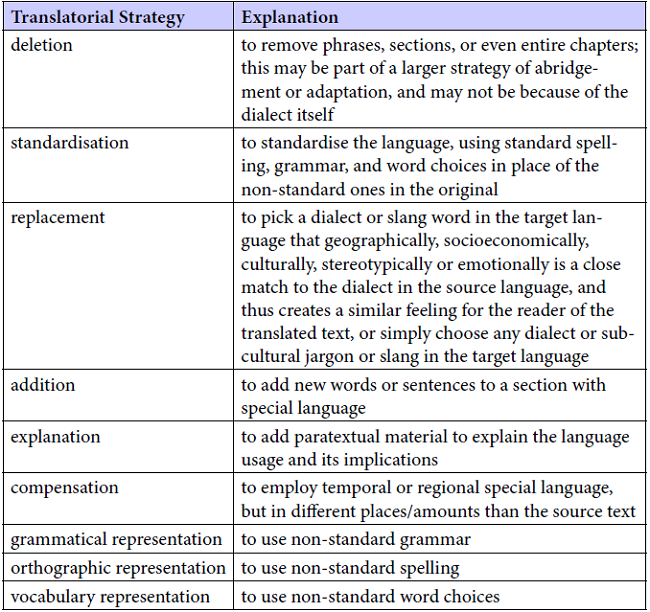
Table 1 (Cont.)
Strategies for translating dialects.

At that place are pitfalls and difficulties associated with each of these methods, and translators must endeavor to find a way to limited the dialect in the target language without exaggerating how it is used or what information technology means. Dialects have to be translated carefully, so that they portray the characters, location, and/or story in the source certificate without mocking them. It is likely that a combination of translatorial strategies might need to exist employed within any given text, and indeed, that is what many of these translators do.
Power and Translation
Power plays a function in how translators choose (or are forced/encouraged to choose) to translate. In contempo years, translation studies scholars have begun using postcolonial theories as a way of analysing the role of translation and translators in communicating beyond cultures. They have establish that colonising cultures could use selective translation, and thus selective translation strategies, as a way of accessing and retaining power over colonised peoples. What languages and texts are translated, and how, relates to the ideology of those who are, or wish to be, in control. As described by Tymoczko and Gentzler in the introduction to their book, translations are "one of the primary literary tools that larger social institutions - educational systems, arts councils, publishing firms, and even governments - had at their disposal to "manipulate" a given society in order to "construct" the kind of "culture" desired" and translations and books were chosen for "their [those in power] ain purposes pertaining to ideology and cultural power" (thirteen, emphasis in the original). The manipulation of literature with the express intention of affecting the audition is therefore an ethical area that demands more than study and attention.
Examples from Twain
In order to go a sense of what translators thought and did, I analysed seven representative sample passages of dialecttwo in Twain's novel and I compared its fifteen translations to Swedish, a language whose culture contains few Africans or other minorities, and whose history includes no serious involvement with slavery. Based on these vii passages, I found that standardisation is the primary translatorial strategy (60%) (come across Figure 1).3 Orthography was used to represent the dialect twoscore% of the fourth dimension and vocabulary 17.1%, while grammatical representations were only employed half dozen.67%, a number I found depression considering how many dialects take a grammar that differs to some extent from the standard dialect. Englund Dimitrova, also, had found that "in translating dialect, and more specifically dialect in directly speech, [at that place are] the observed tendencies towards the choice of more than standard, conventional linguistic forms" (2004, 135). What is lost in a text when the dialect is standardised in translation can be a major part of the story, as it is in Huck Finn. Swedish readers may non understand the characters and the plot nearly as well as readers of the source text. The examples here tended either to erase or exaggerate the dialect; at that place was no middle style.
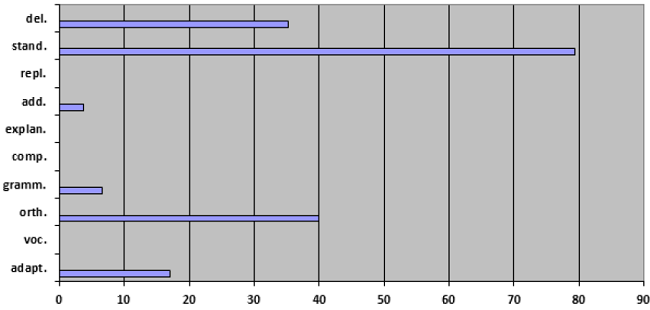
Effigy 1
The strategies in order from most to to the lowest degree interventionist, in percentages.
Past interventionist, I mean how much a given strategy changes a text; I consider the deletion of sections to be very interventionist. Xv translations were analysed for each passage and in some cases, multiple strategies were used inside 1 translation (for example, a translator might delete part of a passage and standardise the rest).
To exemplify this in activeness, we tin look at several quotes. The beginning one is from Huck Finn'southward father, who is uneducated himself and is against education for his son. He is also white. The quote is:
"Looky hither - mind how you talk to me; I'm a-standing well-nigh all I can stand, now - so don't you gimme no sass. I've been in town two days, and I hain't heard zip but most y'all bein' rich. I heard virtually information technology abroad down the river, likewise. That'south why I come up. You git me that money tomorrow - I want information technology" (1999:25).
The language reflects his lack of education and his attitude towards his son. A typical translation is the Swedish one by Sven Christer Swahn:
"Hör nu, passa dig väldigt noga. Jag tål inte hur mycket som helst, så försök inte vara fräck. Jag har varit här i stan två dagar nu och alla människor påstår att du är rik nu. Det skvallras om det längs hela floden. Det är därför jag är här. Du ska ge mig alla de där pengarna - jag behöver pengar" (2001:27).
The back-translation to English is:
"Listen now, you accept practiced intendance. I won't tolerate annihilation, so don't try to be fresh. I have been in boondocks two days now and all the people merits that you lot are rich at present. People are talking almost it along the whole river. That'due south why I'thousand hither. You lot are going to give me all that money - I need coin."
Finn's linguistic communication has been more or less standardised in the Swedish translation. It may exist that Swahn, the translator, thought that information technology was non possible to represent this particular American dialect in Swedish, just surely Huck'due south begetter'southward grammar and pronunciation could be translated in some way, perhaps by creating dynamically equivalent mistakes, such equally "Det är därför jag kommer", "That is why I come/am coming," instead of "Det är därför jag är här", "That is why I am here," for the original "That's why I come." The translator could also have written "mej" instead of "mig", every bit a more orthographic representation of the fashion the word sounds. It is besides possible that Swahn felt that Swedish children ought non or need not exist exposed to dialectal language, and that he used his power equally a translator to make sure this did not happen. Whatever his reasoning, Swedish readers miss out on a significant attribute of the story.
Likewise, some of the phrases sound formal and correct in Swedish. Examples include the phrase quoted in the previous paragraph, and "jag tål inte hur mycket som helst", "I won't tolerate annihilation," and "alla människor påstår att du är rik nu", "all the people claim that you lot are rich now." If Swahn had used an orthographic representation of Huck Finn'southward begetter's linguistic communication, readers at least would be able to hear his voice in a way that they presumably cannot when it has been standardised; representing the pronunciation through spelling is not the same equally using a dialect, but it does say something almost the graphic symbol and his way of talking.
It is rather unfortunate that the varieties of English Twain employed in Huckleberry Finn are not really noticeable in Swedish. Considering of the storyline, Twain's book has to have place in the American South, so choosing a Swedish dialect and/or relocating the story wholesale to Sweden would not take been a expert option. Information technology would probably take been odd for Swedish readers to read, say, the dialect from the northern region of Lappland while knowing that the characters were American. Also, a translator could probably non keep the exact same words in dialect that were in dialect in the original or have quite the same linguistic bug. But it would have been possible to apply non-standard spelling or grammer wherever possible, pronunciation-based spelling (including middle-dialect) instead of standard spelling, and occasional words in dialect, and to attempt to take approximately the same number of "errors" as in English. In this way, Swedish readers would at least recognise that the characters do not use standard language and practice non all speak identically, which is something Twain highlights in his Introduction. In standardising the dialects in The Adventures of Huckleberry Finn, the translators apparently focused on the words in the text and their significant within the story, so the plot itself is clear enough to Swedish readers; but the ways the characters speak, which in turn reveal their location, educational background, social class, race, and other such details, have not come beyond in Swedish, then that some of the atmosphere and sense of the source novel is not carried over. In other words, the national history has been lost to a certain extent; the book becomes plot-based and not nation-based. Huck's adventure is retained, but not the reasons for his adventure or for Twain'due south writing of it, which are, of course, in part to do with the history and status of African Americans and European Americans in the nineteenth century.
The next stage involved comparing three passages in particular (run across Table 2). I was particularly interested to know if all characters were standardised equally in translation. Sample i has Huck's fashion of narration, and this has been standardised in 73.3% of the translations. Huck's anti-instruction male parent, equally reflected in Sample 34, has had his linguistic communication standardised frequently, besides, though not as much (53.iii%). Finally, the language of Jim, the main blackness character in the novel, has been standardised only 6.67% of the time. The Swedish translations take something in common with the German language translations, which Berthele has described as making Jim seem deficient (he does not seem foreign, just "unable to speak any language properly" (608, emphasis original)), though Berthele points out that afterward translations to German tend to standardise Jim's language (604), which may reflect a cultural shift in how minorities are portrayed, or reveal a sense of guilt. As Twain took pains to explain, all of the main characters speak a non-standard dialect in the novel; therefore, that the white characters tend to speak standard Swedish while the black graphic symbol does not certainly implies more than a degree of racism. Hither, translators may be abusing their power past inflicting their own opinions (or those of their editors or publishers) on Swedish child readers. Children may read these works and get the impression that minorities are cognitively scarce, if they have been taught that non-standard dialects are less worthy of credence and respect and are markers of a lack of intelligence; given that the standard dialect is commonly employed in schools and the media, children may indeed get the message that to speak using anything else is a negative sign.
Table two
A comparison of standardisation in three passages.

Sample 5 is a section of Jim's speech communication and information technology is as follows:
"Pooty soon I'll exist a-shout'n for joy, en I'll say, information technology'southward all on accounts o' Huck; I's a free man, en I couldn't ever ben free ef it hadn' ben for Huck; Huck washed it. Jim won't ever forgit you lot, Huck; you's de bes' fren' Jim's ever had; en y'all'south de only fren' ole Jim's got now" (1999:125).
In Swahn'southward Swedish:
"Snart ska jag tjuta av glädje och jag tänker säga, alltsammans är Hucks förtjänst. Jag är en fri man och det skulle jag inte blitt om det inte vatt för Huck, Huck klara det åt mig. Jim ska aldrig glömma det, Huck, du har vatt gamle Jims bästa vän, och nu är du hans ende vän i världen" (2001:95).
Translated back to English language:
"Soon I'll shout with joy and I'll say, it's all thank you to Huck. I am a costless man and I wouldn't have been if it hadn't been for Huck, Huck exercise it for me. Jim will never forget it, Huck, you been quondam Jim'south best friend, and at present you are his only friend in the world."
Much of Jim'south dialect is gone, simply its non-standardness is shown to some extent. The principal remnants are the past particles "blitt" and "vat", which to exist correct should be written every bit "blivit" and "varit", and the phrase "Huck klara det åt mig", which, in standard Swedish, would be "Huck klarade det åt mig". Orthographically, grammatically, and in their implied pronunciation, these translations show some aspects of Jim'due south way of speaking and thus convey his dialect to a certain extent, but TL readers cannot get the same sense of the character that English readers can. Jim'due south skin colour is a vital part of the plot and while it is non but shown through his dialect, the linguistic communication he uses does contribute to the racially stereotyped mode other characters and readers see him, which helps explain why representing his dialect in translation is of import to the story.
Johnsson, some other translator to Swedish, oftentimes uses representation as his strategy. His version of this passage is:
- De ä dej jag har att tacka för'et, Huck, sa han. Skulle aldrig ha blitt en fri human, om du inte hade vari. Du ä den enda vän gamle Jim har. (1964:73)
The dorsum-translation is:
"It's you I have to thank for't, Huck," he said. "Would never accept been a gratuitous me, if you hadn't been. You lot're the just friend old Jim has."
This passage has been shortened, which thus means that some of the dialect has been removed. Nevertheless, Jim's style of voice communication is preserved to a degree, if but through orthographic and grammatical means. "De ä dej" is a pronunciation-based depiction of the standard "det är dig", or "information technology is you", and "för'et" is a shortened version of "för det", or "for it". "Vari" is used for "varit", while Swahn used "vat" for the aforementioned discussion, just as in Swahn's translation, here "blitt" stands for "blivit". This way of talking is non a Swedish dialect in and of itself, but it does evidence that Jim does not speak in a "fine," upper-class way, and that he can be sloppy with his pronunciation and grammar, and information technology emphasises this fact more than than the other translation does. And so target-language readers might assume that Jim is less educated or from a lower class, but at that place is nothing particularly ethnic about his style of speech in the target text, even if it is contrasted in the translation with that of the white characters simply by being more extreme.
In sum, so, these translations very clearly change the text and mislead child readers by showing minority characters as being unable to speak a standard dialect, and also by suggesting that the standard version equates to existence highest on the hierarchy. Again, this is very different from what Twain does in the original. Whereas all the characters speak in dialect in Twain's novel in English, changing this in Swedish gives a different impression to the Swedish child readers. They may not empathize the social and racial groundwork of Huck, Jim, and the other characters, nor will they share Huck's growing understanding of morality and of Jim's equality and humanity.
Conclusion
Marker Twain carefully employs dialects in The Adventures of Huckleberry Finn equally one of the means of representing American history through an adventure story. Readers of the English text will sympathise that all the characters speak in a dialect and they volition besides larn about American history while experiencing Huck's adventures and his increasing awareness of the role slavery has had in the United States. On the contrary, readers of any of the Swedish translations volition feel a very dissimilar text. They will go a sense of minority characters every bit deficient, and mayhap as equitably in inferior situations in life, and they will not get a total picture of slavery and its role in American history. While adult readers, 1 could argue, would possess more outside knowledge to complement what they read in fiction, kid readers may not, especially when it comes to the history of a foreign country. The implication is that translators must be very aware of the ability they wield, and should choose strategies very consciously, so as to allow readers - of whatever age - the greatest exposure to an accurate portrayal of a nation and its history. If this does non happen, and then readers may be exposed to racist credo that can in turn impact order for generations to come.
References
Álvarez, Román, and M. Carmen-África Vidal, eds. (1996). Translation Power Subversion. Clevedon: Multilingual Matters.
Álvarez, Román, and One thousand. Carmen-África Vidal, Translating: A Political Act. (1996). In Álvarez, Román, and Thousand. Carmen-África Vidal, eds. Translation Power Subversion. Clevedon: Multilingual Matters, i-9.
Berthele, Raphael. (2000). Translating African-American Vernacular English language into German: The Problem of 'Jim' in Marking Twain's Blueberry Finn. Periodical of Sociology of language 4/(4), November, 588-614.
Blossom, Harold, ed. (1986). The Adventures of Blueberry Finn. New York: Chelsea Business firm Publishers.
Chambers, J.Thou., and Peter Trudgill. (1980). Dialectology. Cambridge: Cambridge University Press.
Dimitrova, Birgitta Englund. (1996). Translation of Dialect in Fictional Prose - Vilhelm Moberg in Russian and English language as a Instance in Point. In Norm, variation and change in language: Proceedings of the centenary meeting of the Nyfilologiska sällskapet (pp. 49-65) Stockholm: Almqvist & Wiksell.
Dimitrova, Birgitta Englund, "Egennamn vid översättning från ryska till svenska: olika trouble för olika översättare" ["Names in Translation from Russian to Swedish: Different Problems for Dissimilar Translators"], in Langage et référence: Mélanges offers à Kerstin Jonassson à fifty'occasion de ses soixante ans (Uppsala: Acta Universittatis Upsaliensis, 2001), 129-137.
Dimitrova, Birgitta Englund, "En smålänning i engelsk och fransk skepnad - om översättning av dialekt i skönlitteratur" ["A person from Småland in English and French Forms - On the Translation of Dialect in Literature"], in Folkmålsstudier, 40 (2001), nine-27.
Dimitrova, Birgitta Englund, "Från sydöstra Sverige till sydöstra Europa - Vilken bulgariska talar Emil i Lönneberga?" ["From Southeastern Sweden to Southeastern Europe - Which Bulgarian Does Emil i Lönneberga Speak?"], in Per Ambrosiani et al. (eds.), Explorare necesse est: Hyllningsskrift till Barbro Nilsson (Stockholm: Almqvist & Wiksell, 2002), 81-89.
Dimitrova, Birgitta Englund, "Orality, Literacy, Reproduction of Soapbox and the Translation of Dialect," in Irmeli Helin (ed.), Dialektübersetzung und Dialekte in Multimedia (Frankfurt am Main: Peter Lang, 2004), 121-139.
Epstein, B.J. Translating Expressive Linguistic communication in Children's Literature (Oxford: Peter Lang, 2012).
Fishkin, Shelley Fisher, Was Huck Black? Mark Twain and African-American Voices (New York: Oxford University Printing, 1993).
Giddings, Robert, ed. Mark Twain: A Sumptuous Variety (Ann Arbor: University of Michigan, 1985).
Klingberg, Göte, Befouled- och ungdomslitteraturforskning: områden, metoder, terminologi [Research on Children's Literature: Areas, Methods, Terminology] (Göteborg: Lärarhögskolan, 1969).
Klingberg, Göte, Barn- och ungdomslitteraturen [Children's Literature] (Stockholm: Natur & Kultur, 1970).
Klingberg, Göte, Barnlitteraturforskning. En introduktion [Research on Children's Literature: An Introduction] (Stockholm: Almqvist & Wiksell, 1972).
Klingberg, Göte, Översättningen av barn- och ungdomsböcker: en metodisk förundersökning [The Translation of Children's Literature: A Methodological Preliminary Investigation] (Göteborg: Lärarhögskolan, 1974).
Klingberg, Göte, Att översätta barn- och ungdomsböcker: empiriska studier och rekommendationer [Translating Children's Literature: Empirical Studies and Recommendations] (Mölndal: Lärarhögskolan, 1977).
Klingberg, Göte, ed., Children's Books in Translation: the Situation and the Bug. Proceedings of the tertiary symposium of the International Research Guild for Children's Literature (Stockholm: Almqvist & Wiksell , 1978).
Klingberg, Göte, De främmande världarna i barn- och ungdomslitteraturen [Strange Worlds in Children'due south Literature] (Stockholm: Rabén & Sjögren, 1980).
Klingberg, Göte, Children'south Fiction in the Hands of Translators(Stockholm: CWK, 1986).
Knowles, Murray, and Kirsten Malmkjaer, Language Command in Children's Literature (London: Routledge, 1996).
Landers, Clifford E., Literary Translation: A Practical Guide (Clevedon: Multilingual Matters, 2001).
Lathey, Gillian, ed., The Translation of Children's Literature (Clevedon: Multilingual Matters 2006).
Lefevere, André, Translating Literature: Practice and Theory in a Comparative Literature Context (New York: The Modern Language Association of America, 1992).
Lefevere, André, ed., Translation/History/Civilisation (London: Routledge, 1992).
McCormick, Annie, "Dialect in Children's Literature" Associated Content, 16 Dec 2005, <McCormick, Annie, "Dialect in Children'due south Literature" Associated Content, sixteen December 2005, http://www.associatedcontent.com/article/14679/dialect_in_childrens_literature.html> [Accessed 12 December 2006].
Oittinen, Riitta, I am Me - I am Other. On the Dialogics of Translating for Children (Tampere: Academy of Tampere, 1993).
Oittinen, Riitta, Translating for Children (New York: Garland, Inc., 2000).
Oittinen, Riitta, "No Innocent Act: On the Ethics of Translating for Children," in Van Coillie, January and Walter P. Verschueren, eds., Children's literature in translation. Manchester: St. Jerome, 2006, 35-45.
"Svenska dialekter" [Swedish Dialects], <"Svenska dialekter" [Swedish Dialects], http://sv.wikipedia.org/wiki/Svenska_dialekter> [Accessed 21 March 2009].
Swedish Academy'southward Online Lexicon, <http://g3.spraakdata.gu.se/saob/> [Accessed multiple times].
Trilling, Lionel, "Introduction to The Adventures of Blueberry Finn ," in James R. Gaskin & Jack Suberman eds., A Linguistic communication Reader for Writers, 1966, n.p.
Trudgill, Peter, Dialects (London: Routledge , 2004).
Twain, Mark, The Adventures of Blueberry Finn (New York: Norton, 1999).
Twain, Mark, The Adventures of Huckleberry Finn (Berkeley: University of California Press, 2003).
Twain, Mark, Huck Finn, trans. Mogens Cohrt (Copenhagen: Sesam, 1981).
Twain, Mark, Huckleberry Finn, trans. Olav Angell (Oslo: Kagge Forlag, 2003).
Twain, Mark, Huckleberry Finns Äventyr [Huckleberry Finn'due south Adventures], trans. Sven Barthel (Stockholm: Bonniers Juniorförlag 1943, reprinted 1984).
Twain, Mark, Blueberry Finns Äventyr [Huckleberry Finn's Adventures], retold by Maj Bylock (Stockholm: Rabén & Sjögren, 2003).
Twain, Mark, Huckleberry Finns Äventyr [Huckleberry Finn's Adventures], trans. Ingrid Emond, abridgement Comico (Malmö: Skandinavisk press, 1984).
Twain, Marker, Huckleberry Finns Äventyr [Huckleberry Finn 's Adventures], trans. Maj Frisch (Stockholm: Rabén & Sjögren, 1965).
Twain, Mark, Huckleberry Finns Äventyr [Blueberry Finn'due south Adventures], trans. Harry Lundin (Uddevalla: Niloé, 1981).
Twain, Mark, Huckleberry Finns Äventyr [Huckleberry Finn's Adventures], trans. Einar Malm (Stockholm: AB Lindqvists Förlag, 1969).
Twain, Mark, Huckleberry Finns Äventyr [Huckleberry Finn's Adventures], trans. Harald Johnsson (Stockholm: Sagas Berömda Böcker, Svensk Läraretidnings Förlag, 1964).
Twain, Mark, Blueberry Finns Äventyr [Huckleberry Finn's Adventures], trans. Einar Malm (Stockholm: Rabén & Sjögren, 2001).
Twain, Mark, Huckleberry Finns Äventyr [Huckleberry Finn's Adventures], trans. Eva Manchinu (Höganäs: Förlags AB Wiken/Bokorama, 1982).
Twain, Marking, Huckleberry Finns Äventyr [Blueberry Finn's Adventures], trans. Louise Moëll (Malmö: Richters Förlag, 1993).
Twain, Mark, Huckleberry Finns Äventyr [Huckleberry Finn's Adventures], trans. and reworking Walter Nyquist (Stockholm: AB Lindqvists Förlag, 1965).
Twain, Mark, Huckleberry Finns Äventyr [Blueberry Finn'southward Adventures], trans. January Ristarp (Malmö: Förlagshuset Norden, 1974, reprinted Förlags AB Wiken/Bokorama, 1987).
Twain, Mark, Blueberry Finns Äventyr [Huckleberry Finn's Adventures], trans. Gustav Sandgren (Stockholm: Tidens förlag, 1964).
Twain, Mark, Huckleberry Finns Äventyr [Blueberry Finn's Adventures], trans. Sven Christer Swahn (Stockholm: Rabén & Sjögren, 2001).
Twain, Mark, Huckleberry Finns Äfventyr [Huckleberry Finn'south Adventures], trans. Tom Wilson (Stockholm: Björck & Börjesson, 1906).
Twain, Mark, Blueberry Finns Äventyr [Blueberry Finn's Adventures], abridgement, no translator named, (Stockholm: J.A. Lindblads Bokförlag, 1982).
Tymoczko, Maria, and Edwin Gentzler, eds., Translation and Power (Amherst: University of Massachusetts Press, 2002).
Van Coillie, January, and Walter P. Verschueren, eds., Children's Literature in Translation: Challenges and Strategies (Manchester: St. Jerome, 2006).
Wells, David M., "More than on the Geography of 'Blueberry Finn,'" Due south Atlantic Bulletin, 38, 1973, 82-86.
Whitley, John S., (1985). "Kid's Stuff: Mark Twain's Boys," in Giddings, Robert, ed., Marking Twain: A Sumptuous Variety. Ann Arbor: University of Michigan, p. 57-75.
Notes
i All translations from Swedish translations are by me.
2 The passages were from pages 13, xv, 22, 59-60, 111, 237, and 295-6, and they included Huck, his father, Jim, Tom's aunt, Miss Watson, and not first-person narration.
3 Note that percentages exceed 100% because some texts use multiple strategies in one passage.
4 This is the sample given above, which starts "Looky here – mind how you talk to me…"
Author notes
* Senior lecturer in literature and public engagement at the University of East Anglia in England. She's also a writer, editor, and Swedish-to-English translator. She is the author of Are the Kids All Right? The Representation of LGBTQ Characters in Children'south and Immature Adult Lit;Translating Expressive Language in Children'due south Literature; andReady, Set up, Teach!; the editor of two books on translation in the Nordic countries and co-editor ofQueer in Translation; B.J. can be reached at b.epstein@uea.ac.u.k.
b.epstein@uea.ac.uk
bradfordsplad1968.blogspot.com
Source: https://www.redalyc.org/journal/4783/478358393006/html/
0 Response to "Some Readers Criticize Twain Because They Say He Has Again"
Post a Comment